We Use CookiesWe use cookies to enhance the security, performance, functionality and for analytical and promotional activities. By continuing to browse this site you are agreeing to our privacy policy

10 Best Nikon Dslr Cameras 2026 in the United States
How do we rank products for you?

Our technology thoroughly searches through the online shopping world, reviewing hundreds of sites. We then process and analyze this information, updating in real-time to bring you the latest top-rated products. This way, you always get the best and most current options available.

headphones-stars

Our Top Picks

#1

Winner

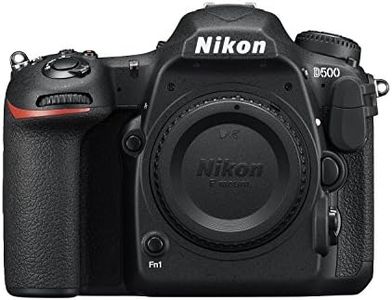
Nikon D500 DX-Format Digital SLR (Body Only), Base

Rating
10.0
Chosen by1,229
Build Quality and Weather Sealing
Frame Rate
Autofocus System

Most important from
489 reviews

Build Quality and Weather Sealing
The Nikon D500 feels incredibly solid and molds comfortably to the hand, with some of the best button placements seen on a Nikon body.
Frame Rate
Burst shooting at 10 frames per second with a large buffer allows capturing fast action effortlessly, making it a true sports and wildlife powerhouse.
Autofocus System
Autofocus performance is among the best tested, with a highly responsive system that excels in tracking moving subjects even in low light.
Battery Life
Battery life impresses with around 1200 shots per charge, though a battery grip is recommended for extended photo or 4K video sessions.
Video Capabilities
4K video recording delivers impressive sharpness and color, with the ability to shoot full 30-minute clips, a major advantage over pricier models.
Connectivity
Wi-Fi, Bluetooth, and NFC enable convenient image transfer to smart devices, although Nikon’s SnapBridge app still has room for improvement.
ISO Range
ISO performance is strong, with usable image quality up to ISO 6400 and an extended low ISO 50 option that helps maximize dynamic range in bright conditions.

The Nikon D500 is a strong choice if you’re after a professional-level Nikon DSLR with a DX-format (APS-C) sensor. Its 20.9-megapixel sensor delivers sharp, detailed images, and the camera handles low-light situations well thanks to its impressive ISO range that goes up to 51,200 natively and can be extended even further. The autofocus system is highly advanced with 153 focus points, making it excellent for tracking moving subjects — great if you shoot sports or wildlife. It also shoots at a fast 10 frames per second, allowing you to capture quick action smoothly.

For video, it offers 4K UHD recording at 30 fps, which is solid for high-quality footage, and the tilting touchscreen LCD adds ease when composing shots from tricky angles. In terms of build, the D500 is rugged and weather-sealed, so it can handle tough conditions better than many other DSLRs. Battery life is decent for long shoots, and built-in Wi-Fi, Bluetooth, and NFC make sharing images convenient.

On the downside, this model is body-only, so you’ll need to buy lenses separately, which might be a consideration if you’re starting out. Also, while it’s packed with features, some might find the menu system complex at first. The Nikon D500 is well suited for serious photographers and videographers who want a durable, fast, and versatile DSLR, especially those focused on action and wildlife photography.

Rating
10.0
Chosen by1,229
Build Quality and Weather Sealing
Frame Rate
Autofocus System

Most important from
489 reviews

Build Quality and Weather Sealing
The Nikon D500 feels incredibly solid and molds comfortably to the hand, with some of the best button placements seen on a Nikon body.
Frame Rate
Burst shooting at 10 frames per second with a large buffer allows capturing fast action effortlessly, making it a true sports and wildlife powerhouse.
Autofocus System
Autofocus performance is among the best tested, with a highly responsive system that excels in tracking moving subjects even in low light.
Battery Life
Battery life impresses with around 1200 shots per charge, though a battery grip is recommended for extended photo or 4K video sessions.
Video Capabilities
4K video recording delivers impressive sharpness and color, with the ability to shoot full 30-minute clips, a major advantage over pricier models.
Connectivity
Wi-Fi, Bluetooth, and NFC enable convenient image transfer to smart devices, although Nikon’s SnapBridge app still has room for improvement.
ISO Range
ISO performance is strong, with usable image quality up to ISO 6400 and an extended low ISO 50 option that helps maximize dynamic range in bright conditions.
#2

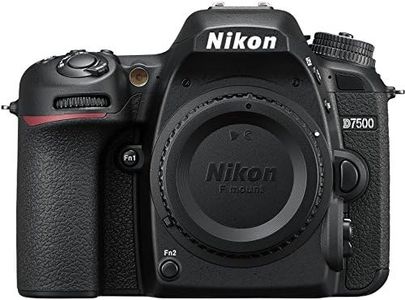
Nikon D7500 DX-Format Digital SLR Body

Rating
9.1
Autofocus System
Battery Life
Build Quality and Weather Sealing

Most important from
1719 reviews

Autofocus System
The camera delivers fast and accurate autofocus, making it easy to capture sharp, low-noise images even in challenging conditions.
Battery Life
Its battery life stands out as a major advantage, lasting through a full day of shooting and outperforming many mirrorless alternatives.
Build Quality and Weather Sealing
The rugged, weather-resistant body holds up well in outdoor environments and minor accidents, maintaining functionality despite drops and rough handling.
Video Capabilities
4K video recording produces clear and pleasing footage, with features like 4K time lapse and power aperture control enhancing creative options.
other
The 18-140mm lens offers excellent image quality across its zoom range and allows quick manual focus adjustments without diving into menus.

The Nikon D7500 is a solid choice for photography enthusiasts and semi-professionals who want advanced features without stepping up to Nikon's highest-end models. Its APS-C sensor with 20.9 megapixels delivers sharp, high-quality images. The camera excels in low-light situations thanks to its wide ISO range, expandable up to 51200, which helps capture detail even in challenging lighting. The 51-point autofocus system, including 15 cross-type sensors, provides reliable and fast focusing, supported by an 8 frames per second continuous shooting rate—great for action or wildlife photography.

Video lovers will appreciate the 4K UHD recording and additional features like 4K time lapse and power aperture control, making it versatile for creative videography. The 3.2-inch tilting touchscreen LCD adds convenience for composing shots at various angles and quick menu access. Its build quality is solid, designed to handle typical outdoor conditions with some weather resistance, although it’s not fully weather-sealed like professional-grade bodies. Battery life is decent for a DSLR, letting you shoot a day’s worth of photos without frequent recharging. Connectivity options, including built-in Wi-Fi and Bluetooth, simplify photo transfer and remote control via the Nikon SnapBridge app.

On the downside, the camera uses digital image stabilization rather than optical, and there’s only one SD card slot, which might concern users who want backup storage. The body weighs about 1.7 pounds, which is manageable but not ultra-light for long shoots. The D7500 effectively balances strong image quality, responsive autofocus, and good video features, making it a versatile DSLR for those stepping up from entry-level models or looking for a reliable secondary camera.

Rating
9.1
Autofocus System
Battery Life
Build Quality and Weather Sealing

Most important from
1719 reviews

Autofocus System
The camera delivers fast and accurate autofocus, making it easy to capture sharp, low-noise images even in challenging conditions.
Battery Life
Its battery life stands out as a major advantage, lasting through a full day of shooting and outperforming many mirrorless alternatives.
Build Quality and Weather Sealing
The rugged, weather-resistant body holds up well in outdoor environments and minor accidents, maintaining functionality despite drops and rough handling.
Video Capabilities
4K video recording produces clear and pleasing footage, with features like 4K time lapse and power aperture control enhancing creative options.
other
The 18-140mm lens offers excellent image quality across its zoom range and allows quick manual focus adjustments without diving into menus.
#3

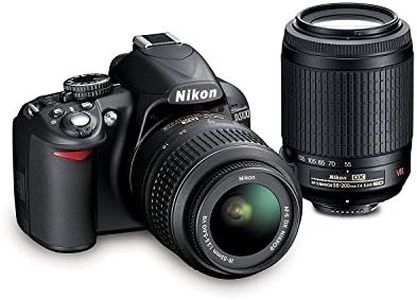
Nikon D3200 24.2 MP CMOS Digital SLR Camera with 18-55mm and 55-200mm VR DX Zoom Lenses Bundle

Rating
8.5
Autofocus System
Video Capabilities
Build Quality and Weather Sealing

Most important from
2008 reviews

Autofocus System
The camera’s action mode enables blur-free shots of moving subjects, making it ideal for casual sports and family events.
Video Capabilities
Video capabilities are basic, offering 1080p recording suitable for hobbyists but missing advanced features found in newer models.
Build Quality and Weather Sealing
Build quality is solid for its class, but the camera is not weather-sealed and should be protected from harsh conditions.
Battery Life
Battery life is impressive, powering through long event days with hundreds of shots without needing a recharge.
Connectivity
Connectivity options are limited with no built-in Wi-Fi, requiring cables or card readers for photo transfer.

The Nikon D3200 is a solid entry-level DSLR camera, great for beginners who want to step up from smartphone photography or compact cameras. Its 24.2MP DX-format CMOS sensor delivers sharp, detailed photos suitable for everyday use and some creative projects. With an ISO range from 100 to 6400 (expandable to 12,800), it performs well in various lighting conditions, although very low light shooting might still show some noise. The 11-point autofocus system with 3D tracking is decent for following moving subjects, but it’s not as advanced as newer models with more focus points. Shooting at 4 frames per second lets you capture moderate action sequences, which is fine for casual sports or family events. Video capabilities are basic, as the D3200 records up to 1080p, which is enough for hobbyist videography but lacks more advanced video features.

Build quality is typical for an entry-level DSLR—lightweight and not weather-sealed, so it’s best kept away from harsh weather. Battery life is reasonable, powering through a good number of shots per charge, which is convenient for day trips or events. Connectivity options are limited compared to newer cameras; no built-in Wi-Fi means transferring photos requires a cable or memory card reader. The included 18-55mm and 55-200mm VR lenses give versatile zoom ranges, making this bundle a good starting kit for various photo styles. In essence, the Nikon D3200 delivers strong image quality and user-friendly controls for beginners while lacking some of the speed, video features, and modern connectivity found in more recent DSLR models.

Rating
8.5
Autofocus System
Video Capabilities
Build Quality and Weather Sealing

Most important from
2008 reviews

Autofocus System
The camera’s action mode enables blur-free shots of moving subjects, making it ideal for casual sports and family events.
Video Capabilities
Video capabilities are basic, offering 1080p recording suitable for hobbyists but missing advanced features found in newer models.
Build Quality and Weather Sealing
Build quality is solid for its class, but the camera is not weather-sealed and should be protected from harsh conditions.
Battery Life
Battery life is impressive, powering through long event days with hundreds of shots without needing a recharge.
Connectivity
Connectivity options are limited with no built-in Wi-Fi, requiring cables or card readers for photo transfer.

Buying Guide for the Best Nikon Dslr Cameras

Choosing the right Nikon DSLR camera can be a rewarding experience, but it requires some understanding of the key specifications that differentiate one model from another. By focusing on these specs, you can find a camera that best fits your photography needs, whether you're a beginner, enthusiast, or professional. Here are the key specs to consider and how to navigate them.
Sensor SizeThe sensor size in a DSLR camera determines the quality of the images and the camera's performance in low light. Larger sensors, like full-frame sensors, capture more light and detail, making them ideal for professional photography and low-light conditions. APS-C sensors are smaller but still offer excellent image quality and are more affordable, making them suitable for enthusiasts and beginners. If you plan to shoot in various lighting conditions and want the best image quality, a full-frame sensor is the way to go. For general photography and a more budget-friendly option, an APS-C sensor will suffice.
MegapixelsMegapixels refer to the resolution of the camera's sensor, indicating how many millions of pixels the sensor can capture. Higher megapixels mean more detail in your images, which is important for large prints and cropping. Cameras with 20-30 megapixels are generally sufficient for most photographers, providing a good balance between image quality and file size. If you need extremely high detail for professional work or large prints, consider a camera with 30+ megapixels. For everyday photography and sharing online, 16-24 megapixels are usually adequate.
ISO RangeThe ISO range of a camera determines its sensitivity to light. A wider ISO range allows for better performance in low-light conditions without using a flash. Cameras with an ISO range of 100-12,800 are suitable for most situations, providing good flexibility in various lighting conditions. If you frequently shoot in very low light or need to capture fast-moving subjects in dim environments, look for a camera with an extended ISO range, such as 50-102,400. For general use, a standard ISO range will be sufficient.
Autofocus SystemThe autofocus system in a DSLR camera affects how quickly and accurately the camera can focus on a subject. More autofocus points and advanced tracking features are beneficial for capturing fast-moving subjects, such as in sports or wildlife photography. Entry-level cameras may have fewer autofocus points, which is fine for general photography and portraits. If you need precise and fast focusing for action shots, look for a camera with a sophisticated autofocus system with many points and advanced tracking capabilities.
Frame RateThe frame rate, measured in frames per second (fps), indicates how many images the camera can capture in a second. A higher frame rate is important for action photography, allowing you to capture fast-moving subjects with ease. Cameras with a frame rate of 5-7 fps are suitable for general photography and occasional action shots. For sports, wildlife, or any fast-paced photography, consider a camera with a frame rate of 8 fps or higher to ensure you don't miss any critical moments.
Video CapabilitiesIf you plan to shoot videos, consider the camera's video capabilities. Look for features like 4K resolution, frame rates, and video-specific autofocus performance. Cameras with 4K video recording provide high-quality footage and are ideal for professional videography. For casual video recording, Full HD (1080p) is usually sufficient. Additionally, check for features like microphone input, headphone jack, and in-body stabilization if you plan to do serious video work.
Build Quality and Weather SealingThe build quality and weather sealing of a camera determine its durability and ability to withstand harsh conditions. Professional-grade cameras often have robust construction and weather sealing, making them suitable for outdoor and challenging environments. If you frequently shoot in adverse weather or rugged conditions, look for a camera with strong build quality and weather sealing. For general use and indoor photography, a standard build without extensive weather sealing will be adequate.
Battery LifeBattery life is an important consideration, especially if you plan to shoot for extended periods or in remote locations. Cameras with longer battery life allow you to shoot more without needing to recharge or carry extra batteries. Entry-level cameras typically offer shorter battery life, which is fine for casual use. For professional or extensive shooting sessions, look for a camera with a higher battery capacity or the option to use battery grips for extended power.
ConnectivityModern DSLR cameras often come with various connectivity options like Wi-Fi, Bluetooth, and NFC. These features allow you to easily transfer images to your devices, control the camera remotely, and share photos online. If you value convenience and quick sharing, look for a camera with robust connectivity options. For those who prefer traditional methods of transferring and sharing photos, connectivity features may be less critical.

FAQ