We Use CookiesWe use cookies to enhance the security, performance, functionality and for analytical and promotional activities. By continuing to browse this site you are agreeing to our privacy policy

10 Best Lithium Battery For Solar 2026 in the United States
How do we rank products for you?

Our technology thoroughly searches through the online shopping world, reviewing hundreds of sites. We then process and analyze this information, updating in real-time to bring you the latest top-rated products. This way, you always get the best and most current options available.

headphones-stars

Our Top Picks

#1

Winner

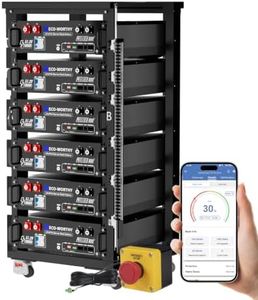
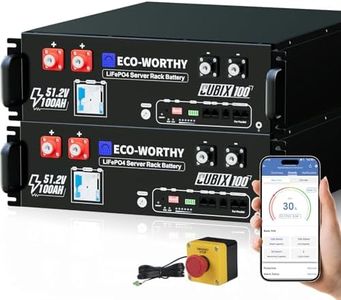
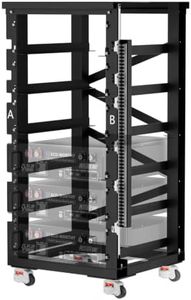
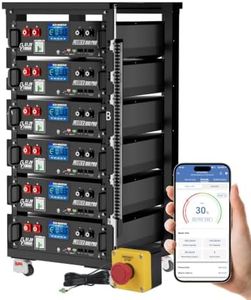
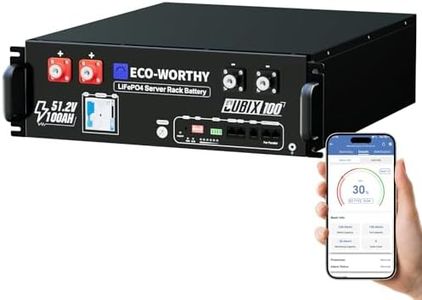
ECO-WORTHY (Cubix 100) 48V 600Ah Server Rack Battery LiFePO4 w/Bluetooth | 6 Pack 30.72kWh Solar Battery Kit for Home Backup | UL1973 & UL9540A & CEC Listed (Get Free 6-Layer Rack with 600A Busbar)

Rating
10.0
Chosen by1,211
Capacity (Ah)
Voltage (V)

Most important from
271 reviews

Capacity (Ah)
The build quality is solid, with the battery maintaining voltage well and matching the promised capacity.
Voltage (V)
The battery’s BMS accurately reports voltage, temperature, and state of charge, ensuring strong performance when properly configured.

The ECO-WORTHY 48V 600Ah LiFePO4 battery kit is a strong choice for home solar energy storage and backup. Its high capacity (around 30.72kWh) and 51.2V output provide ample power for extended use. The battery uses high-quality lithium iron phosphate cells, known for long cycle life and safety, supported by a 10-year limited warranty. It also carries important safety certifications (UL1973, UL9540A, CEC), which means it meets strict standards for electrical and thermal safety.

The design fits neatly into server racks and supports vertical mounting, saving space, and you can link up to 32 units for much larger energy needs. The built-in Bluetooth and WiFi allow easy monitoring via the ECO-WORTHY app, which is convenient for keeping track of battery health and performance. However, the kit is quite heavy at 600 pounds, which might require extra effort or help during installation. While it comes as a plug-and-play setup with all accessories included, its size and weight mean it’s best suited for dedicated home energy systems rather than portable use.

The ability to communicate with popular solar inverters makes system integration smoother but might be more than needed for simple setups. This battery kit offers a dependable, scalable option for homeowners looking for safe, long-lasting solar storage with smart features, though users should be prepared for its physical bulk and installation demands.

Rating
10.0
Chosen by1,211
Capacity (Ah)
Voltage (V)

Most important from
271 reviews

Capacity (Ah)
The build quality is solid, with the battery maintaining voltage well and matching the promised capacity.
Voltage (V)
The battery’s BMS accurately reports voltage, temperature, and state of charge, ensuring strong performance when properly configured.
#2

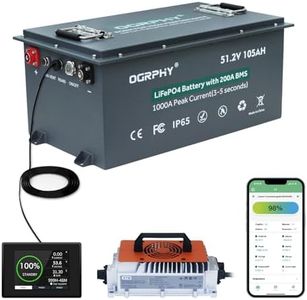
LOSSIGY 48V Lithium Golf Cart Battery with 18A Lithium Charger and Monitor, 48 Volt Battery Conversion Kit, Built in 200A Bluetooth, Peak Current 1000A(3-5s), Prefect for RV, Solar System

Rating
7.9
Weight and Size

Most important from
285 reviews

Weight and Size
The battery significantly reduced the weight of the golf cart by replacing six lead-acid batteries, enhancing performance.

The LOSSIGY 48V 100AH Golf Cart Lifepo4 Battery with 48V 18A Lithium Charger is a robust option for anyone considering a lithium battery for their solar system. One of its main strengths is the high capacity of 100AH and a voltage of 48V, which is well-suited for solar applications. The battery boasts an impressive cycle life of at least 4000 cycles, ensuring longevity, and a 10-year lifespan that offers great value over time.

Additionally, it features a Depth of Discharge (DoD) that supports extended usage without significantly degrading the battery’s life, enhancing its efficiency for solar power systems. The built-in 200A Bluetooth BMS provides smart management and protection, preventing damage from over-current, short circuits, and temperature extremes, which adds to its reliability.

The battery's peak current capacity of 1000A for short bursts (3-5 seconds) is exceptional, making it potentially useful for high-demand applications like golf carts and RVs. Installation is straightforward, and its relatively compact dimensions (10.59)

Rating
7.9
Weight and Size

Most important from
285 reviews

Weight and Size
The battery significantly reduced the weight of the golf cart by replacing six lead-acid batteries, enhancing performance.
#3

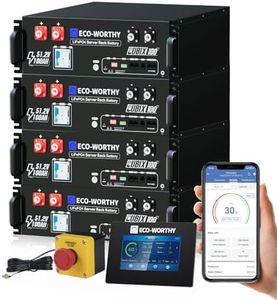
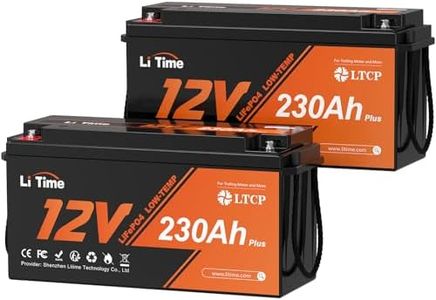
ECO-WORTHY 48V 280Ah (4 Pack 12V 280AH) LiFePO4 Lithium Battery with Bluetooth, Low-Temp Protection, 14.34kWh Energy, for RV, Off-Grid, Solar System, Home Backup, Marine

Rating
7.6
Capacity (Ah)
Temperature Range

Most important from
345 reviews

Capacity (Ah)
Offers substantial power capacity, with users estimating up to 560 amp hours of power, making it a reliable choice for running high-demand appliances.
Temperature Range
Exceptional performance for full-time RVers, enabling extended off-grid stays in varying temperatures without power hookups.

The ECO-WORTHY 48V 280Ah LiFePO4 Lithium Battery stands out as a robust option for solar power systems, especially for applications such as RVs, off-grid setups, and home backups. With a capacity of 280Ah and a voltage of 48V, it offers substantial energy storage, which is particularly useful for extended power needs. The battery also supports 6000+ deep cycles, indicating a long lifespan, which is about three times more than traditional lead-acid batteries. This means it can provide consistent power over many years, making it a reliable choice for continuous use.

The battery is also equipped with Bluetooth and a Battery Management System (BMS), ensuring protection from overcharging, over-discharging, and short circuits, enhancing safety and durability. The low-temperature protection feature is a plus for those in colder climates. In terms of efficiency, the battery promises high performance with fast charging capabilities, both through standard chargers and solar panels. It also has the flexibility of parallel connections, allowing for capacity expansion to meet higher energy demands, up to 57.3kWh.

One of the standout features is its lightweight design; at 62.8 lbs per pack, it is significantly lighter than lead-acid counterparts, facilitating easier installation and handling. However, some users may find the size and weight still considerable when dealing with multiple packs. The charging time varies between 6 to 14 hours depending on the charging method, which is reasonable. Despite its strengths, the battery’s cost might be higher compared to other types, which could be a consideration for budget-conscious buyers. In summary, the ECO-WORTHY 48V 280Ah Lithium Battery is a high-capacity, durable, and efficient solution for solar energy storage, well-suited for heavy-duty and long-term applications.

Rating
7.6
Capacity (Ah)
Temperature Range

Most important from
345 reviews

Capacity (Ah)
Offers substantial power capacity, with users estimating up to 560 amp hours of power, making it a reliable choice for running high-demand appliances.
Temperature Range
Exceptional performance for full-time RVers, enabling extended off-grid stays in varying temperatures without power hookups.

Buying Guide for the Best Lithium Battery For Solar

Choosing the right lithium battery for your solar system is crucial for ensuring efficient energy storage and long-term reliability. Lithium batteries are popular for solar applications due to their high energy density, long lifespan, and low maintenance. When selecting a lithium battery, it's important to consider several key specifications to ensure it meets your energy needs and system requirements.
Capacity (Ah)Capacity, measured in ampere-hours (Ah), indicates how much energy the battery can store. This is important because it determines how long your battery can power your devices. Batteries with higher capacity can store more energy, which is useful for larger systems or longer periods without sunlight. For small systems or short-term use, a lower capacity may suffice. Assess your daily energy consumption to choose a battery with adequate capacity.
Voltage (V)Voltage is the electrical potential difference and is measured in volts (V). It is important because it needs to match the voltage requirements of your solar system. Common voltages for solar batteries are 12V, 24V, and 48V. Higher voltage systems are more efficient for larger setups. Ensure the battery voltage matches your solar panel and inverter specifications to avoid compatibility issues.
Depth of Discharge (DoD)Depth of Discharge (DoD) refers to the percentage of the battery's capacity that has been used. A higher DoD means you can use more of the battery's capacity before recharging. This is important for maximizing the usable energy from your battery. Batteries with a higher DoD are ideal for applications where you need to use a significant portion of the stored energy regularly. For less frequent use, a lower DoD may be acceptable.
Cycle LifeCycle life indicates the number of complete charge and discharge cycles a battery can undergo before its capacity significantly degrades. This is important for understanding the battery's longevity. Batteries with a higher cycle life are more durable and cost-effective over time. If you plan to use the battery frequently, choose one with a high cycle life. For occasional use, a lower cycle life may be sufficient.
EfficiencyEfficiency refers to the amount of energy that can be retrieved from the battery compared to the amount of energy stored. Higher efficiency means less energy is lost during the charging and discharging process. This is important for maximizing the energy you get from your solar panels. Look for batteries with high efficiency ratings, especially if you have limited space for solar panels or need to maximize energy output.
Temperature RangeThe temperature range indicates the range of temperatures within which the battery can operate effectively. This is important because extreme temperatures can affect battery performance and lifespan. If you live in an area with extreme temperatures, choose a battery with a wide operating temperature range. For moderate climates, a standard temperature range may be sufficient.
Weight and SizeWeight and size are physical dimensions of the battery. These are important for installation and space considerations. Heavier and larger batteries may be more challenging to install and require more space. If you have limited space or need a portable solution, opt for a lighter and more compact battery. For stationary installations with ample space, weight and size may be less of a concern.

FAQ