6 Best Hp Scientific Calculators 2025 in the United States

Related Products
Recommended lists
Scientific Calculators
Our technology thoroughly searches through the online shopping world, reviewing hundreds of sites. We then process and analyze this information, updating in real-time to bring you the latest top-rated products. This way, you always get the best and most current options available.

Our Top Picks
Winner
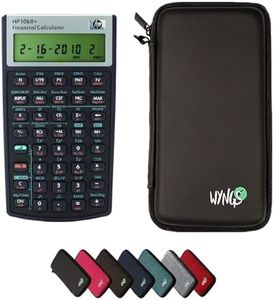
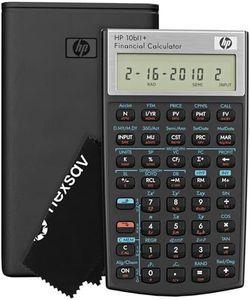
HP 10B II Plus/Hewlett Packard 10BII+ Financial Scientific Calculator + WYNGS Protective Case Black
Most important from
126 reviews
The HP 10B II Plus is designed primarily for business and finance professionals or students who need a reliable calculator for financial calculations. It offers over 100 built-in business functions such as loan payments, interest rates, cash flows, and investment metrics like NPV and IRR, making it a strong tool for financial tasks. The calculator’s display is straightforward, showing information clearly without overwhelming the user. It runs on batteries, which are easy to replace, but you’ll want to carry spares if you use it heavily.
While it’s not programmable for custom functions like some advanced scientific calculators, its preset business functions cover most financial needs efficiently. The calculator comes with a protective case, improving durability during everyday use. Users generally find it simple to operate, even if they aren't tech experts, thanks to its intuitive layout and accessible keys.
A limitation is that it’s more focused on financial calculations and less suited for complex engineering or scientific tasks beyond basics. If you need a calculator primarily for finance or business, this model provides excellent value and convenience. However, those needing advanced scientific programmability might find it limited.
Most important from
126 reviews
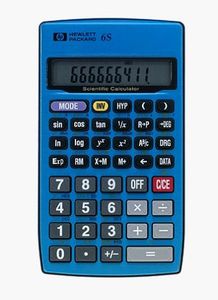
Hewlett Packard HP6S Scientific Calculator
Most important from
5 reviews
The Hewlett Packard HP6S Scientific Calculator is designed as a straightforward and affordable option for middle-school students or anyone needing basic scientific and mathematical functions. It covers essential trigonometry, algebra, base conversions, and arithmetic, making it suitable for general scientific use without overwhelming complexity. The calculator uses a battery power source, so you don’t need to worry about charging but should be mindful of battery replacement. Its display is simple and clear enough to support easy algebraic entry, helping users input calculations without much trouble. While it lacks advanced programmability features found in higher-end models, this simplicity also makes it easier to use and less intimidating for beginners.
The build is lightweight and compact, which is convenient for carrying around, though the thin design might impact long-term durability if handled roughly. Since it was first released in 1999 and is now discontinued, finding new units could be a bit tricky, and it may not include recent updates or enhancements newer calculators offer. For those seeking a no-frills, reliable scientific calculator for basic schoolwork or simple scientific calculations, the HP6S is a decent choice. Those in need of more advanced functions or a more modern display might want to consider newer models.
Most important from
5 reviews
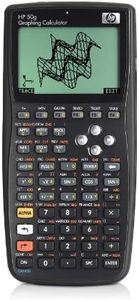
HP 50g Graphing Calculator
Most important from
1374 reviews
The HP 50g Graphing Calculator is a strong choice for anyone needing a scientific calculator with advanced capabilities, especially students and professionals in engineering or math. Its upgraded display offers 30% more usable space than previous models, making it easier to read complex equations and graphs. The large memory, including 512 KB RAM and 2 MB flash ROM, supports extensive calculations and future software updates, which is a plus for long-term use. The inclusion of an SD card slot for memory expansion is convenient, allowing users to save more data or programs directly on the device.
One standout feature is the flexibility in input methods—you can use RPN (a favorite among HP fans), textbook, or algebraic entry styles, catering to different user preferences. The calculator also comes loaded with over 2300 built-in functions and a bigger equation library, which covers a wide range of scientific and engineering needs. On the downside, the HP 50g uses four AAA batteries, which may require frequent replacement compared to calculators with rechargeable or solar power options. The device is fairly lightweight and portable but slightly larger than some other models, so it might not be the best fit if compactness is a priority.
Although the interface is powerful, beginners might find the programmability and multiple input modes a bit overwhelming at first. However, with some time, users can appreciate the depth of features offered. The HP 50g is well-suited for those who want a robust, versatile scientific calculator with extensive functions and good display clarity, though it might have a steeper learning curve and less convenient power source than some newer alternatives.