10 Best Generator For Camping 2025 in the United States

Related Products
Up to 30% off
![[Upgraded Version] ALLPOWERS S2000 Portable Power Station 2000W (Peak 4000W) MPPT Solar Generator 1500Wh Backup Battery with 4 AC Outlets for Outdoor Camping RV Emergency Off-Grid](https://images-proxy.bestreviews.guide/OouIKpk4unEf0t5j_R8qV3SP1_g=/0x300/https://m.media-amazon.com/images/I/51n9OTptdIL._AC_CX679_.jpg)


Our technology thoroughly searches through the online shopping world, reviewing hundreds of sites. We then process and analyze this information, updating in real-time to bring you the latest top-rated products. This way, you always get the best and most current options available.

Our Top Picks
Winner
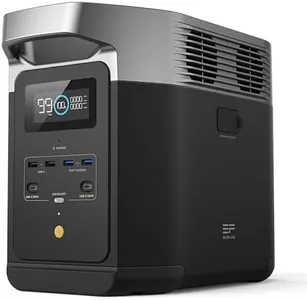
EF ECOFLOW Portable Power Station DELTA 2, 1024Wh LiFePO4 (LFP) Battery, 1800W AC/100W USB-C Output, Solar Generator(Solar Panel Optional) for Home Backup Power, Camping & RVs
Most important from
3784 reviews
The EF ECOFLOW DELTA 2 Portable Power Station is a highly versatile and powerful option for camping and RV trips. With a substantial 1024Wh battery capacity, expandable up to 3kWh, it offers impressive power output. Its 1800W AC output is capable of powering most camping appliances, making it suitable for almost any electronic device you bring along. The inclusion of 15 outlets enhances its practicality, ensuring you can plug in multiple devices simultaneously.
The unit also supports fast charging, reaching 80% capacity in just 50 minutes when using an AC input. This quick recharge capability is highly convenient for short prep times before heading out for a camping trip. Additionally, the option to charge via solar panels (up to 500W input) offers an environmentally friendly alternative, ideal for long outdoor stays or off-grid living. One of the major strengths is its LiFePO4 battery, known for its durability and safety, with a lifespan of over 3000 cycles, ensuring years of reliable use.
Weighing 27 pounds, it's relatively portable but may still be considered heavy for some users. However, its compact dimensions (15.7"L x 8.3"W x 11.3"H) make it easy to store and transport in most vehicles. Additional solar panels for charging aren't included and need to be purchased separately, which could be an added expense. The price point might also be higher compared to less advanced generators. In summary, the EF ECOFLOW DELTA 2 is a robust and eco-friendly choice for campers who need a high-capacity, reliable power source with multiple charging options and the convenience of fast recharge times.
Most important from
3784 reviews
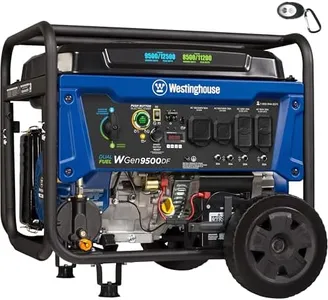
Westinghouse 12500 Watt Dual Fuel Home Backup Portable Generator, Remote Electric Start, Transfer Switch Ready, Gas and Propane Powered
Most important from
24827 reviews
The Westinghouse 12500 Watt Dual Fuel Portable Generator offers impressive power output, making it a suitable option for campers needing substantial power. With 9500 running watts and 12500 peak watts on gasoline, and 8500 running watts and 11200 peak watts on propane, it can handle high-demand devices. The dual fuel capability provides flexibility in fuel choice, which is beneficial for extended camping trips where fuel availability might vary.
The remote start feature, electric and recoil start options, and the included key fob add convenience, allowing easy operation without having to manually start the generator each time. Its 12-hour runtime on a full 6.6-gallon fuel tank ensures long-lasting power, reducing the need for frequent refueling. Safety features such as GFCI outlets with rubber covers, automatic low oil shutdown, and a digital hour meter enhance its reliability and ease of use.
At 210 pounds, this generator is quite heavy and may require additional effort to transport, which could be a drawback for campers looking for highly portable solutions. Despite these considerations, the generator’s power, dual fuel capability, and user-friendly features make it a strong contender for those needing reliable and versatile power in a camping environment.
Most important from
24827 reviews
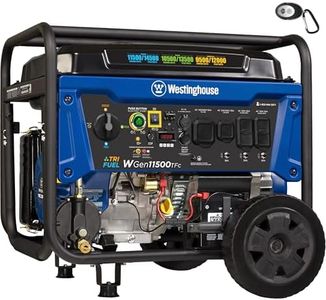
Westinghouse 14500 Peak Watt Tri-Fuel Home Backup Portable Generator, Remote Electric Start, Transfer Switch Ready, Gas, Propane, and Natural Gas Powered
Most important from
1838 reviews
The Westinghouse Outdoor Power Equipment 14500 Peak Watt Tri-Fuel Home Backup Portable Generator is a robust and versatile power solution, ideal for users needing a reliable backup source for home or a powerful option for camping. This generator's significant strength lies in its tri-fuel capability, allowing it to run on gasoline, propane, or natural gas, providing flexibility depending on fuel availability. It boasts a high power output with 14,500 peak watts and 11,500 running watts on gasoline, making it capable of powering multiple devices and appliances simultaneously.
Its runtime is impressive, offering up to 19 hours on a full gasoline tank, though it decreases to 7 hours with a propane tank, which is still reasonable for shorter trips or intermittent use. The remote electric start feature adds convenience, letting you start the generator from a distance. The generator's weight is a notable drawback, as it weighs 230 pounds, which can impact portability and ease of transport—important factors for camping.
The generator is well-built with a durable 550cc 4-stroke engine and includes features like overload protection, automatic voltage regulation, and a CO sensor for safety. It also comes with a 3-year limited warranty and extensive customer service support. For campers seeking a balance of power and versatility and who don't mind the extra weight, this generator is a strong contender.