10 Best Air Compressors 2026 in the United States

Related Products
Up to 25% off
Our technology thoroughly searches through the online shopping world, reviewing hundreds of sites. We then process and analyze this information, updating in real-time to bring you the latest top-rated products. This way, you always get the best and most current options available.

Our Top Picks
Winner
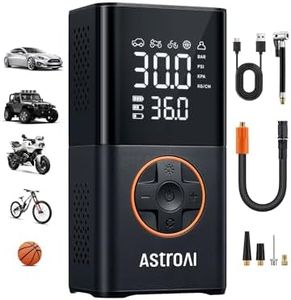
AstroAI L7 Tire Inflator Portable Air Compressor,150 PSI Cordless Mini Air Bike Auto Shut-Off Pump with Digital Display Pressure Gauge, Fast Inflation & LED Light for Car Tires,Motorcycles,Bikes,Balls
Most important from
15471 reviews
The AstroAI L7 Portable Air Compressor is a compact, battery-powered inflator designed mainly for car, motorcycle, bike tires, and sports balls. It offers a maximum pressure of 150 PSI, which is sufficient for most passenger vehicles but not suitable for heavy-duty or large truck tires. The inflator’s tank size is relatively small at 35 liters, but its cordless design and light weight (under 1 pound) make it very easy to carry and store, ideal for road trips or emergency use. One standout feature is its digital display with advanced sensor technology, providing accurate pressure readings and allowing you to preset the desired PSI for different inflatables, which simplifies use and improves safety.
It can inflate a typical car tire from 30 to 36 PSI in about 1.5 minutes, which is reasonably quick for a mini compressor. Its 4000mAh rechargeable battery supports inflating up to 8 tires per charge, making it reliable without needing a power outlet. The built-in LED light with various modes adds practical value for nighttime use or emergencies. The device produces noise around 80 decibels, which is noticeable but typical for small compressors. Due to its portable and compact design, it lacks a large air flow rate (CFM) and tank capacity, so it’s best suited for casual vehicle owners rather than professional or frequent heavy-duty users. If you want a handy, easy-to-use inflator to keep in your car for everyday tire maintenance and occasional emergencies, this model is a strong candidate.
Most important from
15471 reviews
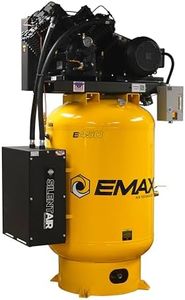
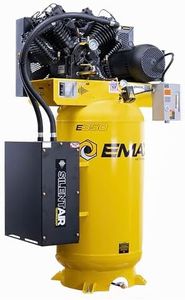
EMAX ESP10V120V1 10 HP 120 Gallon 2 Stage Single Phase Industrial V4 Pressure Lubricated Pump 38CFM@100 PSI Plus Patented Silent Air Compressor
Most important from
2 reviews
The EMAX ESP10V120V1 is a hefty industrial air compressor designed for demanding work environments. With a strong 10 horsepower motor and a large 120-gallon tank, it can deliver an airflow of 38 cubic feet per minute at 100 PSI, making it well-suited for continuous, heavy-duty tasks that require steady air pressure. Its two-stage pump and cast iron build enhance durability and efficiency, ideal for industrial use.
One of its notable features is its patented silent air technology, which reduces noise compared to typical compressors, a big plus if you’re concerned about loud workspaces. However, this model is very heavy at over 1000 pounds and not portable, which means it’s best suited for fixed locations rather than mobile or home garage use. It runs on electric power (230 volts), so it's limited to places with sufficient electrical setup.
If you need a powerful, stationary compressor with a large tank for industrial applications and can accommodate its size and electrical needs, this model could be a solid choice. On the other hand, if portability or quieter operation at a personal workshop scale is important, you might want to consider other options.
Most important from
2 reviews
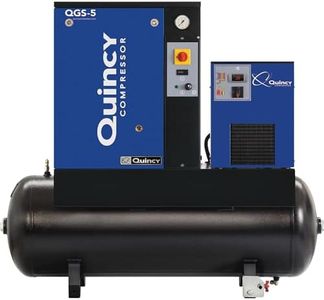
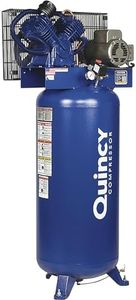
Quincy QGS Rotary Screw Compressor with Dryer - 5 HP, 200/208, 230, 460 Volt 3 Phase, 60 Gallon, 16.6 CFM, Model Number QGS-5TMD
The Quincy QGS Rotary Screw Compressor is a solid choice if you need a reliable and powerful stationary air compressor, especially for industrial or heavy-duty tasks. It offers a strong airflow of 16.6 CFM at 5 horsepower, which means it can run multiple pneumatic tools or spray painting equipment efficiently. With a large 60-gallon tank, it can store plenty of compressed air, reducing the frequency of the motor running and giving you more consistent power.
Its noise level is about 68 decibels, which is moderate—noticeable but not excessively loud, so it won’t be too disruptive in a workshop. The compressor runs on 460 volts three-phase power, so it’s best suited for facilities with industrial electrical setups rather than typical home garages. Although it’s described as portable, its size and weight probably make it less ideal for frequent moving.
This product is excellent if you need steady, high-volume air for professional or industrial use, but it might be overkill for casual or light tasks. Additionally, quieter or smaller compressors might be better if you’re working in a noise-sensitive area or need more mobility.